Thursday, October 14, 2021

Hermanos, Cuates, y la Madre Naturaleza: Karamazov y Quetzalcoatl


En la novela Los Hermanos Karamazov del gran escritor Ruso Fyodor Dostoyevsky hay un pasaje entre dos de los tres hermanos. En ese pasaje llamado “La leyenda del Gran Inquisidor” se debate la Fe, La Iglesia, y la Humanidad entre el hermano aprendiz de monje con el hermano ateo, intelectual.  Alexi  (Alyosha) el hermano “bueno” es devoto, reza, y hace buenas obras, mientras otro de los hermanos Dimitry, pelea en las cantinas, arrastra borrachos con los que pelea entre la nieve y el lodo. Sin embargo, como hermanos se aman aunque Ivan trata de destruir la Fe de Alexi en ese capitulo dedicado a la lucha de la humanidad entre la religión y un ser supremo.


El Gran Inquisidor esta basado en el auge de la Inquisición española con el Obispo imponiendo muerte y castigos a los infieles al tiempo que su palabra no era solo ley sino la propia palabra de “Dios.” Ivan relata la leyenda a Alexi para convencerlo que se salga del convento Ortodoxo en el que estudia. La trama es muy sencilla.


Jesús vuelve al mundo y aparece entre las multitudes que inmediatamente lo reconocen y lo siguen igual como en los tiempos de la Biblia. Empieza hacer milagros y curar a los enfermos. Pronto el rumor le llega al Obispo que lo manda apresar y tiene una larga conversación con Jesucristo que lo deja hablar sin pronunciar ni siquiera una palabra.

El Obispo le reclama. “¿Porque volviste al mundo? Nos costo mas de mil años deshacer lo que tu hiciste. Los hiciste creer que eran libres. Pero son niños que se tienen que castigar para que obedezcan. Ahora tu vuelves a darles esperanzas falsas y deshacer lo que le costo mas de mil años a la iglesia corregir.” 


Al final el Obispo le exige a Jesucristo una respuesta a lo que Jesucristo le besa en la mejilla. El Obispo le abre la reja y le dice. “No vuelvas, porque si vuelves yo mismo hago que esas muchedumbres que tanto te aman te vuelvan a crucificar.”


Al final del pasaje Alexi hace lo mismo con su hermano y le besa en la mejilla sin que Ivan logre que Alexi pierda la Fe en su intención de convertirse en Monje. Dostoyevsky logra a través de ese pasaje exponer la contradicción que existe aun entre la institución de la religión y la Fe en un ser súper natural creador de la vida y el universo.

Como el gran escritor que es expone los dos argumentos para que el lector interprete quien tiene la razón. Pero además hace una critica muy profunda a las instituciones religiosas que se han alejado de la verdadera Fe y como decía el jefe Lakota Leonard Crow Dog nos trajeron una cruz fuera de balance. Por supuesto el se refería a las cuatro direcciones del universo representadas en el árbol de la que se hizo la Cruz.


La enajenación de Dimitry perdido en el alcohol, de Ivan perdido en el intelecto, de Alyosha perdido en la religión es un referente a la humanidad captada por Dostoyevsky hace mas de 150 años. Para Dostoyevsky la salida era la espiritualidad directa con el gran creador sin embargo aun el gran Dostoyevsky no alcanzo a comprender que la conexión con Wakan Tanka, God, Allah, viene a través de su creación misma el sol que nos alumbra, el viento que nos acaricia, el agua que nos da vida, y la tierra que nos alimenta. De lo contrario seguiremos concentrados en una Cruz desnivelada sacrificando a la humanidad en el nombre de Dios.


Salvador Reza


Sunday, October 3, 2021

Noowuh Nation and the Treaty of Guadalupe Hidalgo (US-Mexico 1848)

HUMAN RIGHTS OF INDIGENOUS PEOPLES

Presentation of the 1999 Final Report of the United Nations Treaty Study by Dr. Miguel Alfonso Martinez to Fermina Stevens, Chair of the Noowuh Nation Knowledge Center by Tupak Huehuecoyotl, Izkaloteka on behalf of the Continental Commission Abya Yala, Secretariat TONATIERRA.


Excerpt

49.  It follows that the issue of treaties affecting indigenous peoples as third parties may continue to be relevant insofar as they remain in force and insofar as indigenous peoples already participate - or may in the future - in the implementation of their provisions.  Among the 10 instruments previously considered for analysis, 18  apart from the Lapp Codicil, several others would warrant further scrutiny, among them the 1794 Jay Treaty and the 1848 Treaty of Guadalupe-Hidalgo, both of apparent special significance for the indigenous nations along the borders of the United States with Canada and Mexico respectively.

*************


322.  Finally, in connection with the indigenous affairs related activities of the Office of the United Nations High Commissioner for Human Rights, the Special Rapporteur recommends:


(b)  The establishment, at the earliest possible date, of a section within the United Nations Treaty Registry with responsibility for locating, compiling, registering, numbering and publishing all treaties concluded between indigenous peoples and States.  Due attention should be given in this endeavour to securing access to the indigenous oral version of the instruments in question;


********

Noowuh Knowlege Center


VOICES AND VISIONS:

Revisiting the 1863 Ruby Valley Treaty of Peace & Friendship Gathering

As operating Secretariat of the Continental Commission Abya Yala, we are particularly interesting in the position of the US government in the case where they purport to claim the right to extinguish Shoshone land title by way of "gradual encroachment" of the Ancestral Territories of the Western Shoshone based upon the legaloid and "nefarious" tenets of the Doctrine of Discovery of Christendom.


“The United States claims that the title to the land in question was ceded to the United States by Mexico in 1848, subject to occupancy by the Native Americans. The United States maintains that in 1863, it signed a treaty with the Western Shoshone, referred to as the Treaty of Ruby Valley, and that under the Treaty the United States and the Western Shoshones agreed to end hostilities between them and live amicably. The United States claims that subsequent to the treaty with the Western Shoshones it treated certain lands within the area at issue as lands of the United States.”


Although the US government had announced its intention to recognize the independence of the Spanish-American colonies in 1822, Spain did not recognize Mexico's independence until the Santa María–Calatrava Treaty of December 28, 1836. This was the first case in which the Spanish monarchy acknowledged the independence of a state that had been erected within the limits of her former colonial empire in the New World."


Under the terms of the Santa María–Calatrava Treaty of December 28, 1836 the dominions of Mexico were to be comprised of the former Viceroyalty of New Spain, the captaincy-general of Yucatan, the commandancies of the eastern and the western interior provinces, lower and upper California, along with the annexed territories and adjacent islands. The source of the original purported territorial claim by the Viceroyalty of New Spain in Mexico which was transferred to the Mexico was the royal charters given to Columbus by the monarchy of Spain in 1492 and affirmed from the pinnacle of the imperial structure of Christendom (the Vatican) by Pope Alexander VI via the Papal Bull Inter Caetera of 1493.

Framework of Dominance:
UN Preliminary Study on the Doctrine of Discovery


As we have now engaged the Tom Lantos Human Rights Commission in a public dialogue intended to promote the recognition, respect and guarantees for the Human Rights of Indigenous Peoples, we submit this report to the IACHR mindful of the lack of substantive response by the US government to your request of August 18, 2020 to the US Department of State regarding the case of our dear Shoshone relatives, Mary and Carrie Dann.

We submit here these principles for consideration in the Western Shoshone case going forward with the intent to connect principle with action, recognition with mutual respect, and humanity with the Territorial Integrity of Mother Earth.


 YouTube:

August 13, 2021

Imihuan Tenamaxtle :

The Arrows of Tenamaxtle


Tuesday, September 21, 2021

TONATIERRA: Comisión Permanente Ayotzinapa - Call for Solidarity: Message to MEChA

Open Letter to MEChA

From Comisión Permanente Ayotzinapa
TONATIERRA


Good greetings.  One of the most significant moments in the decades long history of the relationship between TONATIERRA and MEChA as a community based Indigenous Peoples organization was the opportunity to present at the National MEChA conference at UCLA in 2019.  


We were given the opportunity to share with MEChA the report on the solidarity work we have realized with the parents and communities of the 43 Ayotzinapa students forcibly disappeared on September 26, 2014, in Iguala, Guerrero.


Today, after seven years the search for justice for Ayotzinapa continues. We call upon MEChA to stand once again in International Solidarity with the demands by the parents of the missing students for justice and accountability.


On September 26, 2014, in the town of Iguala, Guerrero in Mexico, 43 students from the rural teacher preparation school of Ayotzinapa were Forcibly Disappeared by federal and local police agents of the Mexican state.  Six others were killed that night, including three students and three innocent bystanders shot and killed when the Mexican army attacked the bus the students were taking to Mexico City.  The 43 Ayotzinapa students were unarmed, they were on their way to participate in the commemoration of the massacre of the students in Tlaltelolco Square in 1968. Unknown to the students, was the fact that the bus they were on was also carrying a contraband load of heroin for delivery to the US, in Atlanta and Chicago.


The military and police agents were sent by the cartels of the narco-state in Mexico to recover the heroin, at any cost.


Now, seven years later, the parents, families, and the community of the Ayotzinapa continue to demand accountability and justice not only for the 43 Ayotzinapa students, but also for the tens of thousands of victims of killed and disappeared in Mexico under the shroud of the US backed “War on Drugs” and the US financed Plan Merida Mexico.


As we have consistently done over the past seven years on a monthly basis, TONATIERRA will be organizing a public action in front of the Mexican Consulate in Phoenix, Arizona in coordination and complement to the mobilizations of solidarity in Mexico and across the world from Saturday September 25 to Sunday September 26.  Being a weekend, the event in Arizona will synchronize with a Vigil for Justice in New York City in front of the Mexican Consulate beginning Saturday the 25th at 8:00 PM EST, and close with a March for Justice led by local MEChA students on Sunday the 26th of September.  The March for Justice is being planned for 4:00 PM – 6:00 PM Arizona MST.


We make this call to all of the MEChA chapters across the country to join with us in the campaign to bring the light of justice to the cause of the 43 Ayotzinapa students.


If you are interested in following up with this message, contact:


Comisión Permanente Ayotzinapa

TONATIERRA

Tupac Enrique Acosta

chantlaca@tonatierra.org


YouTube:

¡Ayotzinapa! 

¡Ni perdón, Ni Olvido! 

26 septiembre 2014 – 26 septiembre 2021

Solidaridad Internacional

Comisión Permanente Ayotzinapa

TONATIERRA

Phoenix, Arizona


 Facebook Event Phoenix:


Photos


Wednesday, July 7, 2021

Tlahtol Macehualli: Las Banderas y las Religiones

Comités de Defensa del Barrio

Press Release


El 4 de julio acaba de pasar y los estruendos de los fuegos artificiales vulgarmente conocidos como “cuetes” todavía “retiembla en el centro la tierra” al sonoro rugir del sonido ensordecedor. Miles de perritos asustados terminaron en los asilos de perros y miles de dueños andan frenéticamente buscando sus mascotas despavoridas ante el despliegue artificial.

Algo similar pasa el 16 de septiembre en México, pero allá es mas oficial. Los discursos patrióticos se lanzan desde los balcones en los palacios de gobierno y el grito de Viva México resuena ante el espectáculo de los juegos artificiales iluminando la noche con figuras patrióticas.   Y esto me lleva a mi comentario sobre el patriotismo. El patriotismo es algo similar a la religión a la que perteneces.

Es algo que se ingiere como la leche materna. Entra en el subconsciente y se queda como la religión inculcada de niño. Los cristianos en las cruzadas iban en guerras santas contra los musulmanes. Y los musulmanes hacían lo mismo en las invasiones a España o Constantinopla. Aun hoy en día se luchan guerras entre hermanos por la religión a la que pertenecen. Las religiones se dividen en varias sectas de interpretación de la Biblia.

Los seguidores del intelectual revolucionario mexicano Ricardo Flores Magón pisoteaban la bandera mexicana en sus mítines a riesgo de ser linchados. Su propósito era concientizar a la población sobre como los símbolos patrios solo servían a los intereses de los capitalistas para que los pobres pelearan en sus guerras por intereses petroleros, mineros, o territoriales. Clamaban antes de salir huyendo de las pedradas y los balazos, “esta, esta, es la causa de nuestros males.”


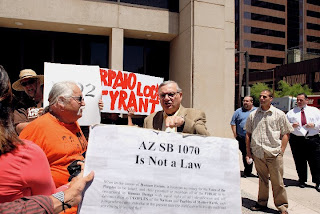
En las marchas contra Arpaio, y contra las leyes racistas de Arizona nosotros le pedíamos a la gente no traer banderas de ningún país porque no se trataba de patriotismo sino de derechos humanos.

Sin embargo, no faltaba alguien que sacaba una bandera mexicana y luego alguien una norteamericana y en lugar de unirnos contra las injusticias terminaban casi a golpes por un trapo pintado que nada tenia que ver con la causa por la que estábamos protestando. La causa eran los derechos humanos de todo mundo, no el patriotismo particular de este o de otro individuo.

Esto se utilizaba después en los medios de comunicación partidaria para desprestigiar la lucha o para criticar la falta de amor al país de tal o cual bandera. En una ocasión un individuo me pidió montar una enorme bandera norteamericana en una grúa que acompañaba la marcha. Le explique que no se trataba de patriotismo, pero la valió y la monto.


Los mexicanos se enojaron y montaron sus banderas aun si mas pequeñas. En una de las intersecciones un chofer norteamericano molesto, toco con la defensa del carro a uno de los manifestantes a lo que inmediatamente el individuo que puso la bandera en la grúa saco su placa de policía y lo obligo a que no siguiera golpeando a los manifestantes.


Y es que la táctica de divide y vencerás es utilizada por los poderosos a través del patriotismo.

Ese policía no izó la bandera en la grúa nomas por hacerlo. Fue asignado por sus superiores para sembrar la división entre los manifestantes y para criticar a los manifestantes ante los medios de que no amaban a estados unidos y por tal no tenían derecho de estar aquí en estados unidos. El patriotismo es tan irracional como pelearse porque eres del América y el otro es de las Chivas Rayadas. Y si no tienes cuidado; por un trapo, no solo pierdes amistades sino en ocasiones hasta la vida.

Salvador Reza