Wednesday, July 13, 2011

La Mancha de Arizona: Pogrom of Persecution - Community Impact of AZ SB1070 (2010-2011)

July 12, 2011


The Comités de Defensa del Barrio today announce that the official report on the Community Impact of AZ SB 1070 (2010-2011), intended to bring forward for public scrutiny the immoral collusion driven by the private prison industry, and their lobbying arm the American Legislative Exchange Council (ALEC) in cahoots with AZ Senate President Russell Pearce (author of AZ SB1070) and law enforcement personalities across the state will be delivered by a CDB delegation to the Major League Ballplayers Owners Association at their next official meeting.


The report will also be delivered to the Major League Ballplayers Association.


The report which will be presented in conjunction and with the support of national and international Human Rights organizations, community organizations and advocates of Human Rights including past Nobel Peace Prize Prize Awardees, is to be submitted as a denunciation of the complicity by the MLB nationally with the normalization of the discriminatory policing legitimized by AZ SB1070 and in particular Ken Kendricks, owner of the Arizona Diamondbacks for his role in contributing financially to the fomentors of the AZ SB1070 legislation.

The private prison industry captures some $5 Billion dollars per year in tax payer profits, as agents of an immoral and corrupt system of corruption and collusion similar to the days of Tammany Hall. 

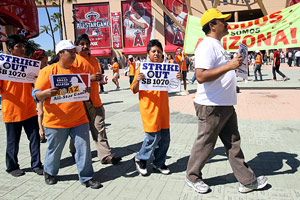
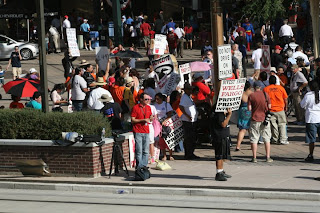
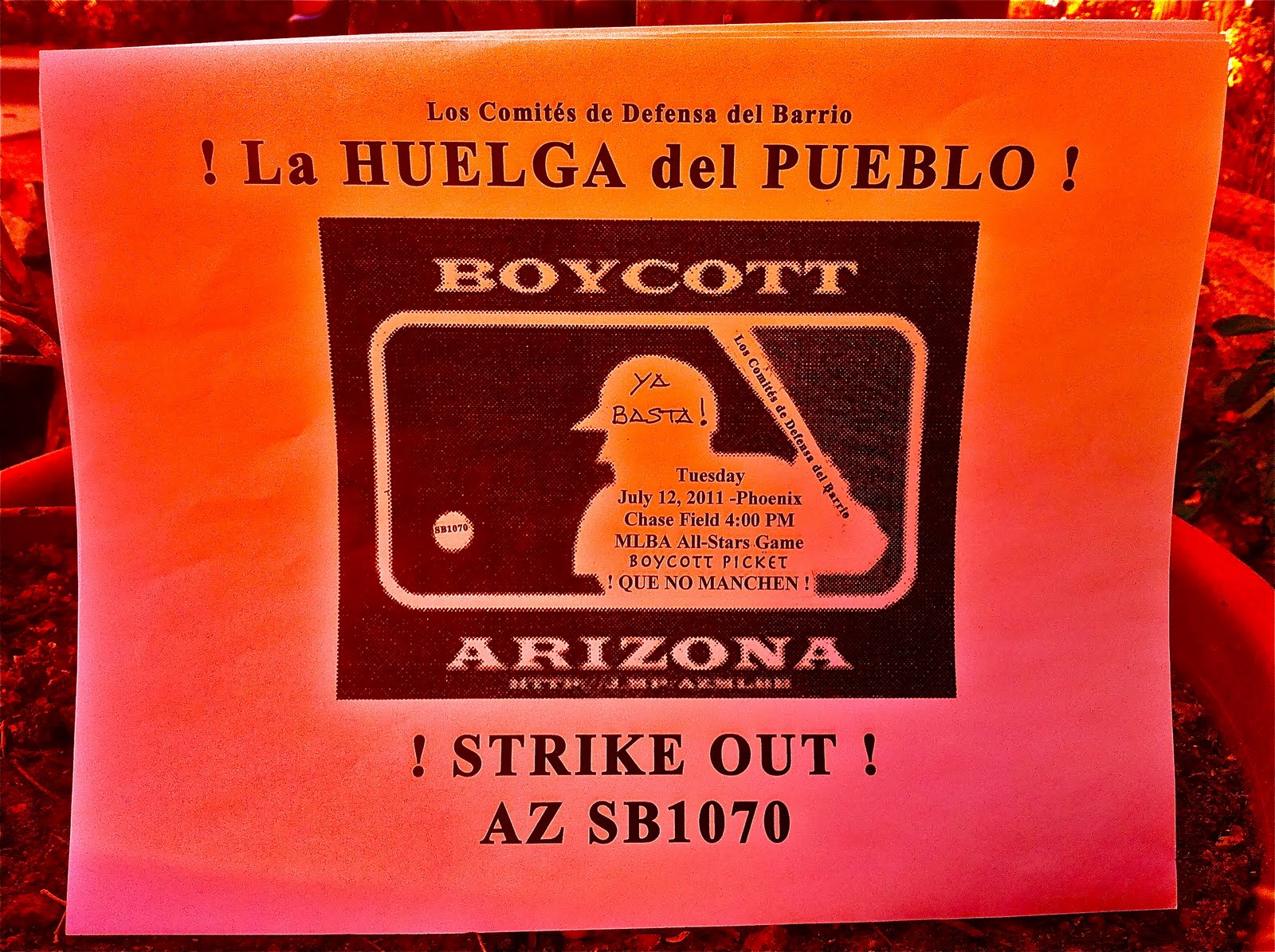
Coinciding with the MLBA All-Stars Game in Arizona, the announcement of the report today by the Comités de Defensa del Barrio also assembled 150 protestors in formation of the Boycott Picket to Strike Out AZ SB1070.

Last year many baseball stars denounced Arizona’s racist law SB1070 and declared that they would boycott the All Star Game if SB1070 was not repealed, including star player Adrian Gonzalez.  A year later, in spite of a partial injunction that came as a result of the federal lawsuit against SB1070, community members testify to the fact that the criminalization of the community is in fact in full effect and worsening.  

“What kind of land that calls itself free, can deny the Spirit of Humanity?” said Tupac Enrique Acosta echoing the theme of the report: La Mancha de Arizona: Pogrom of Persecution - Community Impact of AZ SB1070 (2010-2011) by the Boycott Commission of the Comités de Defensa del Barrio.


The term "mancha' refers to an indelible stain on the character of an individual, organization, or society such as the "stain on the soul" of the German People inflicted by the officialization of state sanctioned racism, doctrines of racial supremacy and manifest destiny, enforced by SS police practices (Secure Communities Program) under the rule of the Adolph Hitler's Nazi Party.


All-Stars urged to bash Arizona immigration law 

THE ASSOCIATED PRESS
By Ronald Blum
Posted: Jul. 12, 2011 | 2:06 a.m.
Updated: Jul. 12, 2011 | 8:18 a.m.


PHOENIX -- The Rev. Jesse Jackson is urging baseball's All-Stars to speak out against the Arizona immigration law, saying they should follow the example set by Jackie Robinson when he broke the game's color barrier more than a half-century ago.


The sport's national spotlight returned this week to the Sonoran Desert for the first time since Luis Gonzalez's ninth-inning single off Mariano Rivera won Game 7 of the 2001 World Series for the Diamondbacks, landing the All-Stars -- those who didn't drop out -- in the hot debate over the law known as SB 1070.


Baseball commissioner Bud Selig ignored calls by some to move today's game.


"It's obviously too late for them to withdraw from the scene," Jackson said Monday during a telephone interview. "I think they should play, and they should speak out, which would be of value."


As players got ready to gather on the air-conditioned diamond under the Chase Field roof, most of them declined to discuss the law. Enacted last year, it requires immigrants to obtain or carry registration papers and calls for police, while enforcing other laws, to question people's immigration status if there is a reasonable suspicion they're in the country illegally.


U.S. District Judge Susan Bolton blocked major provisions last July, a decision the 9th U.S. Circuit Court of Appeals upheld by a 2-1 vote in April. Gov. Jan Brewer intends to ask the U.S. Supreme Court to overturn the injunction.


Boston slugger David Ortiz was one of the few players willing to talk about the law.
"I'm an immigrant. I definitely would never agree with any treating of immigrants bad -- the wrong way," said Ortiz, who is from the Dominican Republic.


Still, he won't get involved with protests.


"I'm not here for that," Ortiz said.


Ortiz captained the American League team in Monday night's Home Run Derby. Sharon Robinson, daughter of the late Jackie Robinson, was on the field before the event for a "Breaking Barriers" presentation.


More typical during player availabilities at the cactus-filled Arizona Biltmore grounds was the response from New York Mets outfielder Carlos Beltran, who will be the National League's designated hitter.


"It's something that doesn't have to do anything with sport," he said. "It's something that affects a certain part of the population."


Somos America, a Phoenix-based Hispanic civil rights group, asked fans, players and coaches to wear a white ribbon showing solidarity against the law.


"Baseball was on the cutting edge of changing the culture with the admission of Jackie Robinson to the game. It changed the American culture in fundamental ways beyond the baseball field," Jackson said. "Some players or some players' families could be disadvantaged or apprehended by that law in Arizona, so it's very risky. I would hope now that they are there, they would at least speak out clearly that that law is in conflict with national law on immigration. States don't set immigration policy.
"Baseball players cannot negotiate away their dignity. I'm glad Jackie Robinson spoke up for dignity beyond the baseball field, and I'd glad Ortiz has spoken up for dignity."


While the temperature outside Chase Field has been as high as 118 this month, an 8,000-ton cooling system keeps it in the 70s inside the ballpark. It was 99 outside and 73 inside for the start of the Home Run Derby.


With the roof closed, as it's been for all games since June 17, there's no fear of haboobs. Those are the massive dust storms, such as the mile-high wall of brown that blew through Phoenix last week.


The AL won 12 straight All-Star Games played to a decision before Brian McCann's three-run double in the seventh inning off Matt Thornton boosted the NL to a 3-1 victory last year in Anaheim, Calif. It was the first time the NL won since the All-Star Game started determining home-field advantage for the World Series in 2003, and the San Francisco Giants went on to beat the Texas Rangers in five games for the title.

NCLR: 2011 All-Stars Game


Janet Murguía, President National Council of La Raza

2011 All-Star Game

On Tuesday night, millions of Latino baseball fans will watch with pride as players with names like Gonzalez, Ortiz, and Reyes take the field at the 82nd Annual All-Star Game. But as the camera pans across Chase Field in Phoenix, Arizona, it will also be a painful reminder that when he had the chance, MLB Commissioner Bud Selig failed to stand up for his Latino players, coaches, and fans by not speaking out against Arizona's war on the Hispanic community.

It's not as if Selig didn't know about the controversy. Last year, when Arizona enacted SB 1070, a discriminatory racial profiling law, the outrage was swift and overwhelming. A coalition of civil rights organizations called both for a tourism boycott of the state and for baseball to move the All-Star Game. Players like Red Sox first baseman Adrian Gonzalez and Blue Jays outfielder Jose Bautista both said the law concerned them. Gonzalez told The San Diego Union-Tribune, "It's immoral. They're violating human rights. In a way, it goes against what this country was built on. This is discrimination." In addition, the MLB Players Association issued a strong statement denouncing Arizona's legislation.

The public responded: Dozens of civil rights, faith, and business organizations joined the call to boycott, costing the state an estimated $752 million in lost convention and tourism revenue. A group of 60 Arizona CEOs signed a letter opposing the state legislature's harmful approach to immigration. Basketball's Phoenix Suns supported the Latino community by wearing "Los Suns" jerseys on Cinco de Mayo, a move endorsed by the NBA Commissioner and NBA players union. Yet from baseball's top official there has been only a deafening silence.

While it is true that SB 1070 is currently tied up in the courts, it is also true that Arizona's assault on its two million Latino residents continues unabated. The state is in dire economic straits, but Governor Jan Brewer vowed to fight SB 1070 all the way to the Supreme Court, spending money that Arizona doesn't have to save a piece of legislation that does nothing to solve the immigration crisis.

Nearly one-third of baseball's players are Latino. Without them, no team can compete in the major or minor leagues. Millions of Hispanic fans buy tickets and spend millions of dollars each year at the ballpark, and they are all at risk of harassment and abuse in Arizona simply because of the way they look or sound. The solution for Selig should be as simple as two plus two: a place inhospitable to Latinos is a place inhospitable to baseball.

It's not too late. Selig can still use one of baseball's most high-profile events to denounce what is going on in Arizona or wear a white ribbon in support of the thoughtful dialogue being organized locally by the Unite AZ coalition. The choice is his, but he should also know that the Hispanic community has the choice to stop supporting a sport that will not stand with us.

Follow Janet Murguía on Twitter: www.twitter.com/jmurguia_nclr

The Week: "The League's silence is shameful."

Opinion Brief

Should MLB players boycott the All-Star Game over SB 1070?

Critics of Arizona's immigration law think that the biggest names in baseball, a sport in which 30 percent of players are Hispanic, are thwarting an opportunity to take a stand against the controversial legislation

The Phoenix, Ariz. Chase Stadium is decked out for the upcoming MLB All Star game: Players are considering a boycott because of the state's controversial immigration law.
The Phoenix, Ariz. Chase Stadium is decked out for the upcoming MLB All Star game: Players are considering a boycott because of the state's controversial immigration law. Photo: Shelly Castellano/ICON SMI/Corbis SEE ALL 71 PHOTOS
Best Opinion:  Huff. Post, Arizona Republic, ESPN

The Rev. Jesse Jackson and opponents of Arizona's controversial immigration law, Senate Bill 1070, are urging Major League Baseball's players to boycott Tuesday night's All-Star Game, which will be played in Phoenix. The law allows police to demand papers from anyone if they have a "reasonable suspicion" the person is an illegal immigrant, which critics say amounts to "racial profiling" of Hispanics. Activists say baseball players should make a stand because roughly 30 percent of pro players are Hispanic, but so far no All-Stars plan to sit out the game. Is that a disgrace, or is this really not their problem? (Watch an ESPN discussion about the controversy.)


The league's silence is shameful: When cameras pan across Major League Baseball's most famous faces Tuesday night, says Janet Murguia at The Huffington Post, "it will be a painful reminder" that Commissioner Bud Selig "failed to stand up for his Latino players, coaches, and fans." Selig should have by publicly denounced Arizona's SB 1070. Now the Hispanic community has ample reason "to stop supporting a sport that will not stand with us."
"2011 All-Star Game"


This is baseball, not politics: "What has happened with the All-Star Game is tragic," says E.J. Montini at The Arizona Republic, but not because players refuse to protest. The state's immigration legislation "isn't their problem." The tragedy is that people are acting like ballplayers are the bad guys because they won't boycott one of the biggest games of the year. Arizona has to deal with this issue "no matter what a group of young millionaire athletes does."
"Not the kind of boycott they wanted"


It is no surprise the players are staying out of it: The "cold truth" of Major League Baseball, says Jeff MacGregor at ESPN, is that the league has "a bad habit of hiding behind Mom and the apple pie whenever trouble starts." It left it to Congress to deal with the steroids scandal, and uses its antitrust exemption as a shield against criticism of greedy owners. By ignoring public pressure to boycott the big game, the All-Stars are just hiding "behind the apple pie again."
"All-Stars, mom and apple pie"

All-Stars, mom and [protests] apple pie

Originally Published: July 12, 2011

All-Stars, mom and protests apple pie

Those promised demonstrations against Arizona's SB 1070 apparently won't happen


As American institutions go, big league baseball has always been more evolutionary than revolutionary. On the field and off. Whenever it's safe and convenient -- say, in a shoe commercial or public service announcement -- Major League Baseball can always be counted upon to take as much reflected credit as possible for the courage of individuals such as Jackie Robinson or Branch Rickey or Curt Flood.

The cold truth of our national pastime is somewhat less inspiring, however, as the game itself has a bad habit of hiding behind Mom and the apple pie whenever trouble starts. Hoping Congress, for example, will clean up the steroid mess; or invoking that red, white and blue antitrust exemption whenever too-greedy owners jingle their cartoon moneybags and put the business model at risk. In fact, Major League Baseball is as hidebound and reactionary as any institution in America, and something of a stooge for the status quo.

Bringing us to this week's All-Star Game in Phoenix, and the inglorious business of business.

Stephen Dunn/Getty ImagesProtestors of Arizona's SB 1070 immigration bill picketed last year's All-Star Game in Anaheim. Will they be in evidence at Chase Field on Tuesday? And if they are, will MLB acknowledge them?

A little more than a year ago, this column got tangled up in the comic opera of Arizona politics. A thing for which the governor of Arizona herself rebutted me very politely here, while some others supported me here.

This was all on account of SB 1070, a piece of Arizona legislation designed to curb illegal immigration. More correctly, SB 1070 was a piece of legislation designed to give the appearance of curbing illegal immigration. It made politicians look tough by stoking folks' fear and prejudice. SB 1070 is a law so bad it had to be rewritten while the ink of the original signatures was still drying. It is law so bad it's been stalled in the courts since the day it was enacted. It is a law so bad it is so far unlawful.

This may be because SB 1070 isn't really a law at all in the conventional sense. It's a piece of performance art. It's community theater.

Sports is a kind of theater, too, of course, which is why it's surprising to me that none of the promised
protests at this week's All-Star Game in Phoenix are likely to materialize. This would seem a perfect moment in which to remind America how many ballplayers are foreign-born (27.7 percent), and how many are of Latin extraction (also 27 percent) and how many come to Arizona every year for spring training (50 percent).


With a few exceptions in this country, we seem to have lost the habit of organized protest. Especially when it comes to sports, there is no counterculture, only consumer culture. Don't rock the boat.

For example: Here's the public statement of Major League Baseball Players Association executive director Michael Weiner. And here's the money quote:

"Our nation continues to wrestle with serious issues regarding immigration, prejudice and the protection of individual liberties," Weiner said. "Those matters will not be resolved at Chase Field, nor on any baseball diamond; instead they will be addressed in Congress and in statehouses and in courts by those charged to find the right balance among the competing and sincerely held positions brought to the debate."
[+] EnlargeJackie Robinson
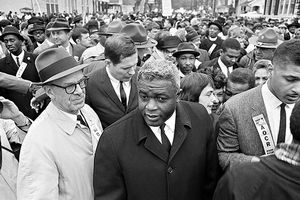
AP PhotoEven after his playing days, Jackie Robinson stayed active in social issues, here joining Rev. Martin Luther King in a march on Frankfort, Ky., in 1964.

Thus does baseball hide behind the apple pie again.

If only Jackie Robinson had waited politely for "those charged to find the right balance!" How much easier things would have been for us all!

Sorry, but no matter how dire the economy or the national emergency, racial profiling is antithetical to the American experiment. If we encourage by complicity, or even by silence, legislation like Arizona SB 1070, we lose whatever battle it is we think we're fighting.

The Constitution needs to be more than just a piece of bright bunting or bit of decorative crepe hung on the hobbyhorse of our preferences and prejudices. Once we sacrifice our founding principles in service of our fears, we give away our right to their protections.

The irony here is that sports are almost entirely pragmatic. They favor what works and discard what does not. American politics, on the other hand, has become a kind of dream state in which ideology trumps ideas and magical thinking is the only kind of thinking we can manage.

Clubhouse or statehouse, our institutions fail us not when we ask too much of them, but when we ask too little.

Jeff MacGregor is a senior writer for ESPN.com and ESPN The Magazine. You can e-mail him at jeff_macgregor@hotmail.com, or follow his Twitter.com feed @MacGregorESPN.

Factbox: State by State - Copycats of AZ SB170 Challenged

Factbox: State crackdowns on illegal immigration


Tue Jul 12, 2011 3:22pm EDT
 
(Reuters) - Several states have passed laws cracking down on illegal immigration since Arizona blazed a path last year with a measure defying the federal government's authority to set national policy.
The states are acting over what they say is Washington's failure to tackle immigration and secure the porous border with Mexico, although several federal judges have since handed down stays blocking parts of these laws.
 

Following are facts on some recent state measures on immigration, and their current status.
 

* Alabama - Republican Governor Robert Bentley signed a law in June requiring police to detain anyone they suspect of being in the country illegally if the person cannot produce documentation when stopped for any reason. The law, which is scheduled to take effect September 1, requires public schools to determine the immigration status of students, punishes employers for hiring workers who are not legal residents and mandates businesses use a database called E-Verify to confirm the status of new employees. It also prohibits landlords from knowingly renting property to an illegal immigrant. Civil rights groups sued to block the law on July 8.
 

* Arizona - A U.S. judge blocked a portion of a tough immigration law, signed by Republican Gov. Jan Brewer in April 2010, that would require police to determine the immigration status of those they have detained and suspect are in the country illegally. In May, the U.S. Supreme Court endorsed separate Arizona immigration provisions, including the right of the state to punish businesses that hire illegal immigrants and requiring employers to check worker citizenship status through a database called E-Verify.
 

* Georgia - Late last month a federal judge issued a preliminary injunction halting the state from implementing measures authorizing police officers to question criminal suspects about their immigration status. The judge also blocked portions of the legislation that would make it a crime to knowingly harbor or transport an illegal immigrant while committing another offense. The remainder of the law, signed by Republican Governor Nathan Deal, took effect July 1.
 

* Indiana - A federal judge in June temporarily blocked a provision of the state law signed by Republican Gov. Mitch Daniels that allows state and local police to arrest anyone ordered deported by an immigration court. The judge faulted the Indiana bill, which was due to take effect July 1, for not requiring the arrested person be brought before a judge for potential release. The judge also blocked a section of the law that would prohibit any person in the state, other than a police officer, from knowingly accepting or offering a consular ID card as a valid form of identification.
 

* Louisiana - In early July, Republican Gov. Bobby Jindal signed two measures requiring the use of E-Verify by businesses. One requires all private contractors who want contracts with state or local public entities to use E-verify. The other requires all businesses to either use E-verify or keep photo ID records on each employee as well as proof they're authorized to work, including copies of birth certificates or naturalization records.
 

* North Carolina - Democratic Governor Beverly Perdue in June signed into law a measure requiring businesses with 25 or more employees to check the citizenship status of job applicants on E-Verify. The legislation will require about 40 percent of the state's businesses to verify the immigration status of new hires following a 24-month phase-in period. It provides an exemption for agriculture companies that employ people such as crop pickers for 90 days or less.
 

* South Carolina - Republican Governor Nikki Haley signed a bill into law in June that requires police to check the immigration status of anyone they stop or arrest for another reason and suspect may be in the country illegally. Under the new law, which goes into effect January 1, employers in South Carolina will be required to use E-Verify to check the citizenship status of employees and job applicants. Penalties for knowingly employing illegal immigrants will include suspension and revocation of a business license by the state.
 

* Texas - The Texas House of Representatives approved a measure that would crack down on cities that provide sanctuary to illegal immigrants. The measure would have prohibited local governments from banning law enforcement officers asking about the immigration status of people who are lawfully detained or arrested. The so-called "sanctuary cities" bill died in late June when the Texas legislature adjourned for another two years without passing it.
 

* Utah - A federal judge in May blocked the enforcement provision in a two-pronged package of immigration laws signed by Republican Governor Gary Herbert in March. The package comprised of four bills Herbert called "the Utah solution," including an Arizona-style enforcement component and another that would create a guest-worker program.
 

* Arizona-style laws have been rejected or failed to advance during the 2011 legislative session in California, Colorado, Iowa, Kansas, Kentucky, Mississippi, Nebraska, New Hampshire, Oklahoma, South Dakota and Wyoming.

(Sources: Reuters; National Immigration Forum and the National Conference of State Legislatures)
(Compiled by Tim Gaynor in Phoenix and Colleen Jenkins in St. Petersburg, and Karen Brooks in Austin; Edited by Greg McCune)

Tuesday, July 12, 2011

Rep. Linda Sanchez Tells The Truth About Senate Bill 1070


Rep. Linda Sanchez

Rep. Linda Sanchez Tells The Truth About Senate Bill 1070


Many politicians have recently spoken out publicly about Arizona’s SB 1070, but few are telling the whole truth. Some, like Rep. Luis Gutierrez, attack the law and rightly argue that it encourages racial profiling. Others take the opposite view, praising Arizona’s law as a response to the failure of the federal government to act. Then you have flip-floppers like John McCain who turned his back on immigrant reform advocates and took “a tougher stand” on immigration in response plummeting opinion polls in a race against anti-immigrant challenger J.D. Hayworth.


At the state level you have anti-immigrant politicians like Daryl Metcalfe who are attempting to pass copycat  laws in their home states. You also have state legislators who are completely opposed to the bill. Up until recently, however, few politicians have spoken out against the organization behind SB 1070, hate group Federation for American Immigration Reform (FAIR).


On Tuesday, California Rep. Linda Sanchez changed that.


Sanchez spoke out against SB 1070 in a radio interview stating,
“There’s a concerted effort behind promoting these kinds of laws on a state-by-state basis by people who have ties to white supremacy groups,” she continued “It’s been documented. It’s not mainstream politics. (Legislators) are being approached by folks, who are front organizations for white supremacist hate groups. They propose the language of these bills and get people to carry these bills in the state legislatures.”
It took a very brave politician to speak out against the anti-immigrant movement behind SB 1070. Rep. Sanchez hit the nail on the head with her comments. The organization Sanchez is referring to, that approaches state legislators like Russell Pearce of Arizona and Daryl Metcalfe of Pennsylvania, is the Immigration Reform Law Institute (IRLI). Sanchez is also correct when she states that the organization(s) are fronts for  hate groups. IRLI is the legal arm of FAIR. FAIR is listed by the Southern Poverty Law Center as a hate group for its strong ties to white nationalism.


In the last few days, FAIR has loudly condemned Sanchez’s comments. Dan Stein, FAIR’s president, stated that Sanchez’s comments have no factual basis. Remember the last time Dan Stein attempted to defend FAIR from its irrefutable ties to white nationalists? That’s right, he was taken apart by Rachel Maddow on her national news program. So let’s show Dan Stein again why his organization, FAIR, is a hate group that has ties to white nationalists. Dan, and anyone else who wants proof, click here and here.


Linda Sanchez didn’t say what people wanted to hear, she told the truth instead; calling out FAIR on its ties to white nationalists and underhanded behavior in American politics. FAIR and its legal arm, Immigration Reform Law Institute, were not shy about taking credit for SB1070, so they should also come clean on their controversial founder and racist associations. Let’s hope Rep. Sanchez’s comments pave the way for more politicians to expose this hate group’s detrimental effects on democracy.