Tuesday, May 29, 2012

La Huelga del Pueblo!


Reportaje Univision 29 de mayo 2012
Video:

es la respuesta de nuestra comunidad al nivel económico contra los intereses que financian la opresión de nuestro Pueblo. Es una lucha permanente, con conciencia y disciplina, implementado con tácticas de BOICOT contra corporaciones especificas que son prioritarios en campañas estratégicas de corto y largo plaza de establecer una ECONOMIA JUSTA y SOSTENTABLE en Arizona.
Nuestro objectivo es de establecer
Zonas de Derechos Humanos
por todo Arizona bajo los principios del
Compacto de Comercio Comunitario de Arizona.

*******************************************

La Huelga del Pueblo
is the response from our community at the economic level in opposition to the interests that financially support the oppression of our Peoples. It is a permanent struggle, with consciousness and discipline, that employs the tactic of strategic BOYCOTTS against priority corporate interests within grass roots strategic campaigns of short and long range intended to achieve a JUST and SUSTAINABLE ECONOMY for Arizona.

Our Objective is to establish
Human Rights Zones 
across the state in accord with the
Facebook:
www.tonatierra.org


Press Release
Los Comités de Defensa del Barrio
TONATIERRA
 
Community Members Assert Principles In Solidarity with the Arizona Boycott
The Boycott Continues

Press Conference

Date:  May 29, 2012
Location:  802 N. 7th Street, Phoenix AZ
Time:  11:00  a.m.
Re:  In light of Supreme Court pending decision on SB1070 and the Sound Strike announcement that they will no longer actively ask Musical Groups not to come to Arizona the Barrio Defense Committees with 13 chapters in Arizona and TONATIERRA announce the set of principles we ask of anyone visiting Arizona.  The Arizona Boycott Continues!

1.  Groups, organizations, performers in Sovereign Native Land coming with the blessing of the indigenous nations are welcome. “Los Tigres del Norte” are scheduled to come there in September.

2.  Groups, organizations, performers coming in Solidarity with the Boycott of Arizona are welcome in “Non-Commercial” venues as long as there is no fees charged at the door and no revenue goes to the coffers of the State of Arizona. “Manu Chao” the European performer showed how it can be done last year.

3.  As long as SB1070 stays in the books the Boycott against Arizona Continues

4.  The Barrio Defense Committees reserves the right to Pickett and actively boycott any group, performer, or commercial enterprise that blatantly or indirectly supports Arizona’s hate laws or gives comfort or economic support to the spread of SB1070 type laws here in Arizona or nationally. Vicente Fernandez will be picketed in July of this year.

5.  The affected community called for the Arizona Boycott and only the affected community has the ultimate authority to call if off.

6.  We thank the Support of Zack de La Rocha and the Sound Strike since the racist laws went in effect as well as all other national organizations such as NCLR (National Council of La Raza), and NDLON (National Day Labor Organizing Network). However, the Barrio Defense Committees and Tonatierra assert the original principles issued when the Boycott was called in front of the State Capitol after the passage of SB1070. 

“The Boycott against Arizona will continue until SB1070 is eradicated from the books of the State of Arizona.”  

Saturday, May 26, 2012

TERRACIDIA y La Ley de Excepciones: Canto Wirikuta


El TLC y La Declaracion sobre Derechos de Los Pueblos Indigenas de la ONU

La Ley de Excepciones
Desde lo Cierto al Desierto de
WIRIKUTA
Inline image 1
Mensaje de Solidaridad y Compromiso al
WIRIKUTA FEST
Mexico, Tenochtitlan


“Han sido siglos y siglos pero para nosotros ya no son, por que nosotros no somos seguidores de los siglos.  Nosotros somos contadores de los cielos.”

“Nosotros no somos inmigrantes en cualquier parte de nuestro continente.”
Marco Loera
“Lo que se llama Internet nomás es la manifestación y la tecnología ahora evidente lo que siempre ha estado presente.  Pero desde la dimensión espiritual de inter-relación: Internet Espiritual: que tenemos con agua y tierra, con viento y fuego - allí si son las comunicaciones reales y allí por estos medios también le vamos hacer llegar la verdad de las cosas.”


TONATIERRA
Embajada de Pueblos Indígenas
*******

YouTube: 
TupakHuehuecoyotl
*****************
Facebook:

Friday, May 25, 2012

Native Contingent Leads Anti AZ SB1070 March

This is the sign held by the Native contingent at the anti-S.B. 1070 march.

Standing in solidarity with indigenous migrants

By Shadi Rahimi, Today correspondent
Story Published: Jun 4, 2010


PHOENIX – As an estimated 100,000 people marched six miles May 30 to protest Arizona’s new immigration law, they were led by Lakotas, Paiutes, Yavapai-Apache, Tohono O’odham, Akimel O’odham, and other tribal members.

Those in front held a banner that read, “Lakota-Nation: America Was Built With Stolen Land. No Border. No Boundaries.”

Shannon Rivers, an Akimel O’odham who organized the march, said they were marching in solidarity with “brothers and sisters” crossing the borders, and for the right of mobility for indigenous people.  Rivers said Senate Bill 1070 – which would make the failure to carry immigration documents a crime and give the police the power to detain anyone suspected of being in the country without citizenship – is a racist bill that should be repealed.

“We, as indigenous people, have been dealing with immigration since the Spaniards and Europeans came. We need to remind them, they too are immigrants. This is the first of many bills to come in the age of xenophobia and post-9/11 laws.”

A majority of those crossing the border from Central America to the U.S. are indigenous people who have been negatively affected by the North American Free Trade Agreement, Rivers said, and U.S. industries that have displaced them from homelands, extracted their resources, and contaminated traditional means of income and sustenance, such as corn.

At a juvenile detention center in Nogales, Mexico, just south of the Arizona border, most of the youth who are deported by U.S. Immigration and Customs Enforcement are from pueblos in southern Mexico.

Youth ages 10 to 17 sat on the concrete floor of the courtyard at the detention center, talking and joking as they waited for family members to pick them up.

Some only spoke indigenous languages and could not communicate with the Spanish-speaking staff. Those who could said they tried to cross the border to the U.S. to find work. Others were looking for parents who had crossed successfully.

Only one youth knew where their parent was. She was 14 and was trying to reach her mother in Pennsylvania. She was caught by ICE near the border of Arizona. When she refused to remove her shoelaces, they took her 700 pesos, she said. She and other youth were taken to a U.S. detention center where they were piled into a cold room for three nights, she said.

The girl plans to cross again, as did most other youth at the center. One 15-year-old boy said he planned to try again that night, after he was picked up by family.

Many are from Oaxaca, Puebla, Guerrero, Chiapas, Michoacan, Veracruz and Sonora – all communities that have been affected by deforestation, contamination of corn and by U.S.-operated factories, the loss of lands or the devaluing of the peso since NAFTA passed.

“There’s lots of kids from the pueblos, who are Indian,” a program director named Isabel said through a translator. “They are hard workers who just want a better life.”

Trying to cross is dangerous, especially for the girls, staff said. Last month, they received a 15-year-old girl who had been raped by U.S. immigration officials, several staff members said. And they recently received a 15-year-old boy who had his ribs broken by U.S. immigration officials when he tried to run.

Such stories are common, said a staff member named Ruben. “We hope you can do something about the way your government treats our children.”

Across the Arizona border, on the Tohono O’odham Reservation, tribal member Mike Wilson has been trying to help migrants crossing the border.

At Saturday’s protest, Wilson brought a map showing the locations of 17,555 migrant deaths that have occurred over the past decade.
“That’s why I put out water barrels for the migrants, so that they do not die. At least 100 migrants who cross through Tohono O’odham lands die every year from dehydration.”

The Tohono O’odham government recently took a stand against S.B. 1070, but Wilson criticized his government for their lack of “humanitarian aid.” They seized his four water stations in the Baboquivari District, which he said is the “deadliest migrant trail in the U.S.”

Today, about nine O’odham communities in Mexico are separated by the U.S./Mexico border. O’odham must produce passports and border identification cards to enter the U.S.

“On countless occasions, the U.S. Border Patrol has detained and deported members of the Tohono O’odham Nation who were simply traveling through their own traditional lands,” according to the O’odham Nation. “Border officials are also reported to have confiscated cultural and religious items, such as feathers of common birds, pine leaves or sweet grass.”

Such restrictions on the movement of indigenous people are why David “Smoky” Daniels traveled from Los Angeles to attend the protest.  He rode a bike on which he taped a sign that read “Yaqui Nation.” As a tribal member, Daniels said he was there to fight against racist legislation.

“I want to nip this in the bud, it’s like a cancer and I don’t want it to spread to California. My people welcome all, unless you came to fight. That’s why I’m here, to fight what they’re doing. It is shameful.”

Monday, May 21, 2012

La Ley de Excepciones

Sunday, October 30, 2011


SOLIDARIDAD con WIRIKUTA desde ARIZONA


Carta Abierta a los Ministros de Estado y a las Constituyentes Públicas de Canadá, Estados Unidos, y México.


El TLCAN y la Declaración de la ONU sobre los Derechos de los Pueblos Indígenas.

27 de octubre de 2011


Saludos. Hoy en día el arco antiguo de la peregrinación de las Naciones y Pueblos Indígenas de Anahuac, la Isla de la Tortuga de Abya Yala [las Américas] a propósito se cruza una vez más con la trayectoria del gobierno de los estados-naciones que ustedes representan en nuestro continente.  Hoy en día los representantes tradicionales de la Nación Wixarika llevan el caso de la Defensa de Wirikuta, el corazón sagrado de México, a un primer plano de la agenda nacional, internacional, y mundial de discusión sobre los Derechos de los Pueblos Indígenas, y los Derechos de la Madre Tierra.  Como Nican Tlacah, estamos en una peregrinación a fin de generar el conocimiento colectivo necesario entre toda la sociedad humana a lo sagrado de la vida para ser vivida, celebrará, y a ser protegida en los territorios de origen y sitios sagrados de los Pueblos Indígenas.

Hoy, en la Ciudad de México, y en la Embajada de Canadá en México, se entrega una petición para exigir el respeto y la protección de los lugares sagrados de Wirikuta a los gobiernos de México y Canadá. Estamos aquí-ahora, Nican Tlacah Izkalotecah, entregando nuestra solidaridad y el compromiso de corregir las injusticias históricas y sociales que han creado la complicidad inmoral e ilegal de los intereses corporativos y funcionarios del gobierno que deben defender el bien común y no actuar como agentes de los beneficios monetarios empresariales .
Contexto:

·      Dentro de las disposiciones del Tratado de Libre Comercio (TLC) de 1994, entre sus gobiernos, cada Estado-nación se reserva el derecho de negar los derechos de los inversionistas o preferencia otorgados a los "poblaciones autóctonas", "minorías, social y económicamente en desventaja”, o " los grupos social o económicamente en desventaja”, en dos a cinco áreas designadas.  Estas disposiciones de excepción se citan en el Anexo II, de la siguiente manera:

  • “Canadá se reserva el derecho de adoptar o mantener cualquier medida denegando a inversionistas y a sus inversiones o a proveedores de servicios de otra Parte cualquier derecho o preferencia otorgados a poblaciones autóctonas.”

  • Estados Unidos se reserva el derecho de adoptar o mantener cualquier medida que otorgue derechos o preferencias a las minorías, social y económicamente en desventaja, incluyendo aquellas sociedades organizadas de acuerdo a las leyes del Estado de Alaska de conformidad con la Alaska Native Claims Settlement Act .
  • “México se reserva el derecho de adoptar o mantener cualquier medida que otorgue derechos o preferencias a los grupos social o económicamente en desventaja.”
En referencia a esas disposiciones de excepción del TLCAN, la profesora Valerie J. Phillips correctamente declaró, "Los tres estados-naciones se recuerdan de los pueblos indígenas, pero sólo en el  tiempo suficiente para ponerlos en su lugar.  Todas estas excepciones sólo continúan con el actual subordinación y marginación de los Estado-naciones a los pueblos indígenas.

Los términos de subordinación y marginación son sólo la piel de la bestia.  El proceso real que ha llevado a cabo sin quebrada ninguna desde 12 de octubre 1492 es el colonialismo y el genocidio, implementado a través de los acuerdos comerciales y políticas de desarrollo económico que favorecen a los procesos de colonización por los elites del “hombre blanco” Europeo-americanos en todo el continente, y sus cómplices empresariales.  La Niña, la Pinta, la Santa María, el Mayflower: el TLCAN y el NARCO.

La invasión de la Isla Tortuga Abya Yala sigue, sin embargo, nuestra resistencia como los pueblos indígenas también continua.  Resistimos y nos rebelamos, nos regeneramos y hacemos un llamado una vez más hoy en día para realizar la rectificación y la claridad, como el propósito y la solidaridad mundial de los hijos de las Naciones y Pueblos de la Madre Tierra.

Aclaraciones:

La Declaración de las Naciones Unidas sobre los Derechos de los Pueblos Indígenas, adoptada por la Asamblea General de 13 de septiembre 2007:

Artículo 32

Los Estados celebrarán consultas y cooperarán de buena fe con los pueblos indígenas interesados por conducto de sus propias instituciones representativas a fin de obtener su consentimiento libre e informado antes de aprobar cualquier proyecto que afecte sus tierras o territorios y otros recursos, particularmente en relación con el desarrollo, utilización o la explotación de recursos minerales, hídricos, o de otro tipo.

Es evidente que la falta de procesos y rendición de cuentas por violaciones de los Derechos de Consentimiento Libre, Previo, e Informado de los Pueblos Indígenas es un defecto fatal - no sólo en las consultas que condujeron al TLCAN como un pacto comercial regional, pero para el actual aplicación en curso del tratado.  El caso de Wirikuta, en México se refleja en la crisis de las arenas bituminosas Tar Sands de Alberta, Canadá y el Cerro Tenabo, en Nevada, así como decenas de otros proyectos de desarrollo que afectan las naciones indígenas de América del Norte, como los Picos de San Francisco en Arizona.  La violación del derecho de Consentimiento Libre, Previo, e Informado se extiende en toda la gama de programas de desarrollo económico que sean promovidos y protegidos con las políticas económicas preferenciales por los tres gobiernos del régimen del Tratado de Libre Comercio de América del Norte (TLCAN).

La violación del derecho de Consentimiento Libre, Previo e Informado, es sistémico bajo las políticas neoliberales de estos estados, así como su complicidad en la explotación y la expropiación criminal de los recursos naturales y el labor de nuestras Naciones y Pueblos. Este es un grave problema de crisis en la política exterior regional que deben ser tratado bajo las normas de la Declaración de las Naciones Unidas sobre los Derechos de los Pueblos Indígenas, aprobada por la Asamblea General de la ONU el 13 de septiembre de 2007.

Centrándose en el contexto de los EE.UU. de esta problemática, Anthony Bothwell, señala que la toma de América por los Europeos consistió en "el robo de la tierra más extensa y la más grande holocausto de la historia mundial".  Él argumenta persuasivamente que, dentro de los Estados Unidos, la Corte Suprema ha distorsionada "leyes" internacionales o doctrinas en cuanto a la conquista y el descubrimiento con fin de "racionalizar la usurpación por la concepción de supremacía blanca sobre la soberanía de las naciones indígenas, aunque reconoció que esta gran injusticia podría haber violado los principios del derecho internacional".  Bothwell va más allá del mero análisis de las leyes internacionales existentes en esos tiempos para afirmar que la toma de Norte America violó a tratados vinculantes, el derecho de naciones tal como se reconoce en la Constitución de los EE.UU., así como los cláusulas de la Supremacía, Comercio, Tomás, y la Quinta Cláusula de enmienda para el Debido Proceso de la Constitución de los EE.UU..

Sin embargo, a pesar de estas evaluaciones y predicciones de la Narrativa del Dominante, hoy los Wixarika levantan su voz al mundo una vez más desde los altares ceremoniales de México en la peregrinación de propósito y aclaración.  Los Cuachilchicameh Izkaloteca responden y transmiten este mensaje siguiente, una vez más:

Proclamación Continental
Abya Yala
Foro Permanente de Cuestiones Indígenas
Quinto Periodo de Sesiones   15-26 de Mayo, 2006
Naciones Unidas  NY, NY

Recordando la memoria, el esfuerzo y espíritu de nuestros ancestros de los Pueblos Milenarios, los que han dado originación a nuestros Naciones y Pueblos Indígenas del Continente Abya Yala;

Retomando el poder de nuestro destino como Pueblos de la Humanidad;

En salvaguardia de los Derechos de las Futuras Generaciones de Nuestros Pueblos Indígenas;

Invocando los Mandatos Ancestrales de nuestra Confederación Continental del Águila y el Cóndor, y las pronunciaciones al respecto tomados en Cumbre Continental Indígena en Quito, Ecuador 2004 y en Mar de Plata, Argentina 2005;

PROCLAMAMOS

Al presentarnos como Naciones y Pueblos Indígenas de Nuestro Continente Abya Yala frente esta quinta periodo de sesiones del Foro Permanente de Cuestiones Indígenas de las Naciones Unidas, y al haber ser recibo como tal por sus autoridades convocantes en el salón de Asamblea General,

Que la Bula Papal Inter Caetera de Papa Alejando Sexto 1493 es NULLIFICADO, también igual cualquier Doctrina de Descubrimiento procedente que pretende deformar la relación de Armonía, Justicia, y la Paz de Nuestros Pueblos Indígenas de la Humanidad entera.

18 de mayo, 2006


CONCLUSIÓN

Hacemos un llamado a los ministros de gobierno en todos los niveles de Canadá, Estados Unidos, y México, y los constituyentes públicos de sus respectivas sociedades para hacer frente sin prejuicios ni discriminación de las aclaraciones anteriores.  Afirmamos que estas aclaraciones obligan la rectificación del crimen del colonialismo y una moratoria sobre todos los proyectos de desarrollo económico dentro del TLCAN que afectan los territorios de las Naciones y Pueblos Indígenas hasta que el Consentimiento Libre, Previo, e Informado de los pueblos indígenas es plenamente reconocido, respetado, y protegido en el espíritu de la Declaración de la ONU sobre los Derechos de los Pueblos Indígenas, de la siguiente manera:

"Afirmando que los pueblos indígenas son iguales a todos los demás pueblos, …."

NAHUACALLI
Embajada de los Pueblos Indígenas

Sunday, May 20, 2012

Immigration and Theology

Immigration and the Indigenous Theology of Tupac Enrique Acosta
by Colin Bossen, guest contributor
Speaker Tupac Enrique Acosta, Tonatierra
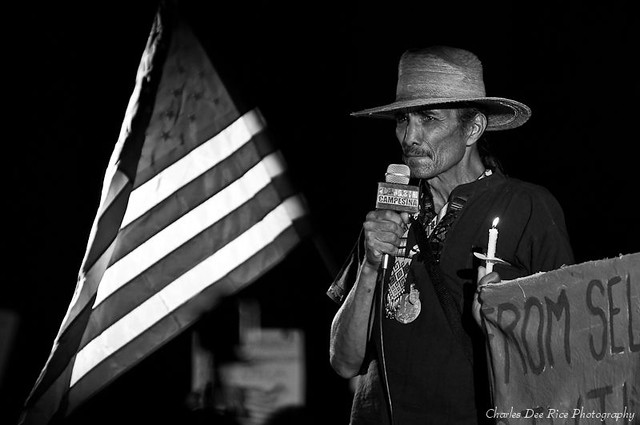
Tupac Enrique Acosta speaks at march to the Arizona State Capitol Building on Cinco de Mayo 2010. (photo: ©Charles Dee Rice Photography/Flickr )

YouTube:

I did not go to jail expecting to meet a theologian. But jail was where I met Tupac Enrique Acosta. Tupac, like me, was arrested in front of one of the Maricopa County Sheriff’s offices for protesting against Arizona’s anti-immigrant law SB1070 on July 29, 2010. Unlike me, Tupac had an analysis of the bill’s place in history that put it firmly within the context of the ongoing repression of the indigenous peoples of North America.

Tupac, who would probably reject the label theologian, is the leading figure behind the Phoenix-based Nahuacalli, an organization that describes itself as “A Cultural Embassy of the Indigenous Peoples.” He is also closely linked with TONATIERRA the grassroots organization behind many protests against SB1070 in Phoenix, and Human Rights advocate Salvador Reza. 

Understanding his views on SB1070 illuminates that, for some, the struggle over immigration is about something larger.

In Tupac’s view the history of SB1070 does not begin in 2010. It begins in 1492 with Christopher Columbus’s arrival in the Western Hemisphere. Columbus’s “discovery” of the Americas prompted European political and religious leaders to develop what indigenous activists refer to as the “Christian Doctrine of Discovery.” This is the belief that because the lands of the Western Hemisphere were without Christians prior to 1492 they were free for the taking upon “discovery.” For activists like Tupac, the issues as stake in SB1070 are not so much political as theological.

Tupac shared his analysis with me as we waited to be processed through the legal system in holding cells and, later, when we were bunkmates in the cell block. More than once our conversations were interrupted when we were moved, it appeared arbitrarily, between cells. They were also interrupted when the Maricopa County Sheriff Joseph Arpaio came into our cell to “talk” with us. Sheriff Arpaio, who is currently under investigation by the United States Department of Justice Civil Rights Division, runs what he likes to call “America’s toughest jail.” He is known for his tactics of intimidating and dehumanizing prisoners, including trying to humiliate male prisoners by placing them in pink underwear and pink handcuffs.

Rather than intimidate us, Arpaio served as an unwitting example for our impromptu seminar on the Christian Doctrine of Discovery. Tupac suggested to me that the logical outcome of a legal system grounded in such a doctrine is laws like SB1070 and men like Sheriff Arpaio. SB1070 would not exist without the doctrine. Arpaio exists to enforce it.

As we sat together in jail, Tupac traced the history of the Christian Doctrine of Discovery from its origin to its often unacknowledged presence in contemporary debates about immigration. He suggested that the doctrine was first articulated in Pope Alexander VI’s 1493 Papal Bull Inter Caetera and the 1494 Treaty of Tordesillas between Spain and Portugal. Together these documents created a theological and legal framework that justified the expropriation and division of indigenous lands by Spain and Portugal.

In the view of Tupac and many indigenous legal scholars the framework created to facilitate the seizure of indigenous lands continues to form the core of much of federal property law today. This is particularly true as it relates to indigenous property claims. The indigenous legal scholar Steven Newcomb, for example, has found traces of the Christian Doctrine of Discovery within U.S. Supreme Court cases as recently as 2001.

Tupac believes that the principles of the Christian Doctrine of Discovery are operative in SB1070 as well. As he told me, “the purpose of SB1070 was to consolidate the perceptions of some white Americans around the idea of an America that is white in a continent that belongs to them.” In his view, SB1070 is just another attempt to assert non-indigenous dominance over the continent. After all, SB1070 is designed to enforce a border that divides not only the United States and Mexico but the indigenous peoples who belong to the Uto-Aztecan language group. They have been moving back and forth between what is now the U.S. and Mexico long before either country existed. SB1070 criminalizes their traditional freedom of movement.

As Tupac understands it, the struggle against SB1070 is the continuing indigenous struggle against colonialism. As he said in a talk, “When we did that marching… we didn’t come to legalize ourselves before the state of Arizona. We came to legalize Arizona… Now, let’s get this clear, colonization is illegal… If we’re going to legalize Arizona we have to decolonize Arizona.” 

Elsewhere he has written that “SB1070 is not a law.” He makes this claim because he believes that the entire framework of laws governing immigration rest upon the Christian Doctrine of Discovery. For him, the Mexican and Central American migrants are indigenous and those who would keep them from coming to the United States are the descendants of colonizers.

Tupac and I were briefly reunited when I traveled back to Arizona to stand trial. After a day-long trial, which touched on none of these issues, the judge ruled us not guilty. Then Tupac set to work again to educate people about the Christian Doctrine of Discovery and passed around a flyer titled “SB1070 is Not a Law.”

Colin BossenColin Bossen is minister of the Unitarian Universalist Society of Cleveland. You can read more of his thoughts on his blog, The Latest Form of Infidelity.
This essay is reprinted with permission of  Sightings from the Martin Marty Center at the University of Chicago Divinity School.
We welcome your original reflections, essays, videos, or news items for possible publication on the Being Blog. Submit your entry through our First Person Outreach page.
Source: divinity.uchicago.edu

Link:
Indigenous Peoples Forum on the Doctrine of Discovery
Arizona State Capitol House of Representatives
March 23, 2012

Wednesday, May 16, 2012

Global Indigenous Youth Caucus Statement


Tuesday, May 8, 2012

Global Indigenous Youth Caucus Statement

YouTube:
Global Indigenous Youth Caucus
Monday May 8, 2012
 
“The Doctrine of Discovery and Domination is a perpetuation of global human rights violations that have yet to be properly recognized and remediated on the international stage.”

“Borders of the states that divide indigenous, lands, territories communities and nations were not established with free, prior and informed consent.  Such policies result in human rights violations of the families of indigenous youth.”

“The Global Indigenous Youth Caucus recommends that the United Nations fully recognize the criminality and dehumanization of the Discovery Doctrine of Christiandom. Truth combined with reconciliation does not mean a thing without acknowledgment of the crimes committed.”

Global Indigenous Youth Caucus Statement on the Doctrine of Discovery and Biocolonialism


Eleventh Session, United Nations Permanent Forum on Indigenous Issues

New York, 7-18 May 2012
Statement on the Doctrine of Discovery (and Biocolonialism)
Agenda Item 3

Presented on behalf of the Global Indigenous Youth Caucus:

Thank you, Mr. Chair;

As previously addressed, the Doctrine of Discovery and Domination is a perpetuation of global human rights violations that has yet to be properly recognized and remediated on the international stage.  We additionally urge the Forum and relevant actors to equally consider all Indigenous Nations and Peoples when discussing Discovery Doctrine.  At this Eleventh Session of the UNPFII, all of the Indigenous Youth in attendance have made a common family bond with each other as members of the Indigenous Nations of Mother Earth.  Yet the Doctrine of Discovery and Domination is being used to justify the separation of Indigenous youth from their families by the border enforcement policies of the states.  These borders of the states that divide Indigenous lands, territories, communities, and nations were not established with free, prior and informed consent.  Such policies result in human rights violations of the families of Indigenous youth.

At this time, the Global Indigenous Youth Caucus wishes to acknowledge our elders, our ancestors, and all of their efforts to set the platform for our delegations today.  We further wish to recognize our peers who cannot be here with us, the seven generations that will follow us, and all living beings in creation.  The crux of the distinct rights of Indigenous Nations and Peoples is the right to self determination, which is subjugated under the social construction of superiority at the foundation of the Doctrine of Discovery.  Conversely, our future depends on creativity and imagination for safeguarding self-determination combined with the right to free, prior and informed consent, and complete inherent and inalienable rights of Indigenous Nations and Peoples, thus serving the purpose of benefiting future generations and the Rights of Mother Earth.

The Global Indigenous Youth caucus recommends that the united Nations fully recognize the criminality and dehumanization of the Discovery Doctrine of Christendom.  The extent of sub-dehumanization carried out in the name of the Discovery Doctrine created the need for standard-setting for international human rights protections.  Truth combined with reconciliation does not mean a thing without acknowledgement of the crimes committed; here conflict reduction and overall healing depend on the willingness of those who inherit the legacy of the crime, including the Pope, to fully confront denial of the Doctrine of Discovery and Domination and embrace recommendations for healing the intentional goal of spiritual dispossession by the doctrine.

The world Intellectual Property Organization (WIPO) fashions an extension of Discovery Doctrine that shifts focus from the mindset of the fraudulent 1823 United States Supreme court case Johnson v. M'Intosh to the corporate theft of the inner sanctums of life itself.  The policies and language put forth by WIPO develop the continuation of the exploitation of cultural heritage through the market economy with the intent to patent life, even though life is not created by corporations or other regulations.  We request that the General Assembly of WIPO extinguish the mandate of the
Intergovemmental Committee on Intellectual Property and Genetic Resources, Traditional Knowledge and Folklore. We further request that the mandate of WIPO is canceled altogether, because we reject this present-day piracy organization.

Biocolonialism is also facilitated through the Nagoya Protocol on Access and Benefit sharing (ABS) of the convention on Biological Diversity, in conjunction with the world Trade organization's Agreement on Trade-Related Aspects of Intellectual Property Rights (TRIPS).  Consequently, Discovery Doctrine must be fully understood in the context of its utilization in the development of various stages of international law, definitions of sovereignty, and revoked from the current missions of global institutions.

Moreover, Indigenous Nations deserve equal standing with full veto rights on the international stage.  Acknowledgment of the collective, inherent and inalienable rights of Indigenous Nations and Peoples, based on self-determination, must be articulated within international norms.  Recognition of the right to self-determination is upheld by Article 1 of the International Covenant on Economic, Social and Cultural Rights, as well as Article 1 of the International Covenant on Civil and Political Rights.  Additionally, states must support the inclusive rights of Indigenous Nations and Peoples to free, prior and informed consent.  General Recommendation No. 23: Indigenous Peoples, of the International Convention on the Elimination of all forms of Racial Discrimination (CERD) provides a strong framework for FPIC, which must be applied in its entirety every time Indigenous Nations and Peoples are directly affected and subjected to proposals for development and commercialization by states and corporations.

We remind the Permanent Forum that one of the obligations for signatories of the convention on the Rights of the child is to respect and understand Indigenous Nations and Peoples.  The central goal of this commitment is to fight prejudices and racism.  Thus states are obliged to teach citizens about the colonial history of the current state system.  Taking this framework into consideration, states ought to be obliged to have a curriculum that addresses the Doctrine of Discovery and Domination and the establishing construct of colonialism/ imperialism of the particular state.  The Discovery Doctrine must be known as a conqueror-based doctrine similar to other racist notions, namely the National Socialism of World War II and Apartheid against colonized peoples, both previously addressed on the international stage.

We additionally voice our significant concerns over state interpretations of the fundamental elements of the Declaration on the Rights of Indigenous Peoples.  Collectively, we reiterate the need for respect of the Declaration, along with the necessity to educate our own youth and generations to come about the Discovery Doctrine, its legacy and subsequent historical trauma.  In the wake of strategic attempts at ethnocide, Indigenous languages around the world still suffer from marginalization and language genocide.  Indigenous languages are the most complex languages in the world; yet many of our languages are disappearing as a result of the legacy of the Doctrine of Discovery and Domination.  A strong, organized effort needs to be made to preserve and recover all of our Indigenous languages so that future generations of Indigenous Nations and Peoples can re-establish Indigenous social structures and decision-making bodies and continue to safeguard the well-being, wisdom and survival of Mother Earth.

###

Statement by the Global Indigenous Peoples Caucus


Monday, May 14, 2012

Statement by the Global Indigenous Peoples Caucus


United Nations Permanent Forum llth Session
New York, 1-18 May 2012
Item 3 Discussion on the special theme for the year:
 
"The Doctrine of Discovery: its enduring impact on indigenous peoples and the right to redress for past conquests (articles 28 and 37 of the United Nations Declaration on the Rights of Indigenous Peoples)."

Presented by Arthur Manuel, Global Indigenous Caucus

Thank you Mr. Chair.

The Global Caucus recommends that the Permanent Forum acknowledge that the doctrine of discovery, both in theory and in on-going practice, constitutes the subjugation of peoples to alien subjugation, domination and exploitation.  It is the denial of fundamental inherent human rights, is contrary to the Charter of the United Nations and is an impediment to the promotion of world peace and cooperation.

Further, we implore the Permanent Forum to acknowledge and to transmit to other agencies of the United Nations that the doctrine of discovery is an expression of racism, xenophobia and discrimination - that it represents a regime of systematic oppression and domination by one racial or religious group over another, and it is committed to the intention of maintaining that regime. As such, the continuing operation of the doctrine of discovery should be recognized as a crime against humanity and should be condemned as such.

We propose, as the Permanent Forum's Expert Group Meeting next year, the development of models and mechanisms for conflict resolution, restitution, redress and peace-building using the framework offered through the operation/implementation of articles 27, 28 and 40 of the UN Declaration on the Rights of Indigenous Peoples.

The proposed focus would be to discuss and make proposals for the development of such mechanisms at the national and international levels.

The Expert Group Meeting would serve as an opportunity for Indigenous peoples of the various regions of the world to discuss the development of mechanisms for reparations, non-recurrence and conflict resolution, taking into account as well Articles 18 and 19 of the Declaration regarding participation and Free, Prior and Informed Consent.

In this regard, we further propose the inclusion of Indigenous knowledge, innovations and practices in the EGM.  Indigenous youth and Indigenous women must be among the experts included at the EGM.

We further recommend that the UNPFII prepare an International Study on the dominating, dehumanizing, and terracidal effects of the international construct known as "the Doctrine of Discovery" upon the health, physical, psychological, social, well-being, human and collective rights, lands, resources, medicines, titles to such lands, resources, medicines - and particularly on Indigenous women as manifested in forms of conceptual and behavioral violence against them.  The Study will be submitted to the UNPFII in 2014 as an addendum to the UN Year of Indigenous Peoples, with recommendations addressing the issues of the discoveries and findings of this Study.

We appreciate and endorse the inclusion of the concept of environmental violence in the report of the UNPFII international expert group meeting entitled "Combating violence against indigenous women and girls: article 22 of the United Nations Declaration on the Rights of Indigenous Peoples" submitted under item 3 of the 11th Session, and encourage the Permanent Forum to continue addressing this critical matter in future discussions.

We endorse the Statement of the Indigenous Women's Caucus under Item 3 to this Session of the Permanent Forum. We anticipate the report of the 2nd International Indigenous Women's Environmental and Reproductive Health Symposium and look forward to working with Permanent forum and Indigenous Peoples to implement its recommendations.

Further to this endorsement, we propose that an International Study be carried out providing review and assessment of all UNPFII recommendations, including their implementation, respecting Indigenous women with a particular focus on the dehumanization and violence against Indigenous women.  Indigenous women should be specifically consulted and recognized for their expertise on these matters.  The proposed study would canvas a wide range of issues and challenges, such as the role of women in the creative innovations of Indigenous cultures and knowledge systems, maternal health and related rights, and the lack of protection of rights of Indigenous women under domestic legislation such as labor laws, criminal laws and environmental laws.

Further to article 29 and 32 of the UN Declaration, that the theme of the UNPFII 13th Session be focused on Mining and Extractive Industries and impact on Indigenous peoples within the context and the mandate of the UNPFII.  We also propose as a future theme the criminalization of Indigenous Peoples in the exercise of their rights.

We also encourage you to consider including a half-day focal discussion on the critical issue of the World Bank, its impacts on Indigenous Peoples, and policy changes needed to implement the UN Declaration.

Finally, we recommend that permanent seats in the United Nations General Assembly be established for Indigenous Peoples.

In conclusion, we are cautious in light of the fact that through the continued use of non-Indigenous languages, terminology and perspectives in describing the doctrine of discovery, we may inadvertently encourage the reproduction of such perspectives amongst our own peoples. The Doctrine of Discovery is a multi-faceted concept.  The Global Caucus understands the concept of the doctrine of discovery as applying worldwide, not limited to Christian or European colonization and domination.  The same inhumane treatments have and continue to be imposed upon Indigenous Peoples in all regions of the world, perpetuating exclusion, racism and discrimination, alienation from decision making processes and "invisibility" within state institutions, even within the international fora.

It must be recognized that in fundamental terms, the doctrine of discovery challenges the just claims of Indigenous Peoples, in particular with respect to processes of decolonization and the implementation of Article 3 of the Declaration respecting self-determination.


The discussion of the doctrine of discovery must include reference to domestic legislation of member states, such as immigration legislation, as well as challenge the establishment of state borders, which do not reflect the traditional lands and territories of Indigenous peoples, that have been established further to the doctrine of discovery.  We fundamentally disagree with the current practices of states to criminalize the movements of Indigenous Peoples across borders.

The doctrine may be understood in contemporary terms as a Doctrine of Development, with Indigenous peoples and Mother Earth subject to domination and subjugation under corporate hands. State governments facilitate the doctrine of discovery for the purpose of development and privilege the rights of corporations while negating, derogating and abrogating the rights of Indigenous Peoples. 

We draw the attention of the Permanent Forum to the recent recommendations of the Committee on the Elimination of Racial Discrimination in their reviews of Canada and the United States, which require the state parties to take measures to prevent transnational corporations registered in Canada and the United States from carrying out activities that negatively impact on the enjoyment of the rights of Indigenous Peoples in territories outside their state borders, and hold them accountable.  Furthermore, national and international financial institutions, including banks, contribute to criminal and detrimental activities that violate the rights of Indigenous peoples.  Issues related to lands, waters and other territories of Indigenous Peoples are not limited to actions of the private sector or state governments.  The Global Caucus is deeply concerned about the militarization of Indigenous waters, lands and territories where such lands and territories are rich in natural resources. In effect, Indigenous Peoples are being killed or displaced to "clear the land" for development.

Indigenous legal and judicial systems exist today.  Indigenous knowledge systems exist today. Indigenous languages continue to be spoken.  We have not been overcome by the doctrine of discovery, in spite of the continued application of this doctrine, in all regions of the world. We will continue to exercise and assert our rights as described in the UN Declaration and in our own Indigenous laws.